
How delegates travelled to the WSA Sustainability in Sport Conference 2025
A Snapshot of This Year’s Event
This year’s WSA Sustainability in Sport Conference brought together NGBs, local authorities, partners and sector leaders for a full day of conversations about climate action, accessibility and the future of Welsh sport.
With sustainability running through every part of the programme, it felt natural to look at something that shapes every event experience: how people actually travelled to get there.
Travel is often the biggest contributor to an event’s overall footprint. For this year’s Conference, we took a closer look at the journeys delegates made and how different travel choices played a part.
The insights below are based on travel plans submitted through the WSA Travel Assistant, powered by our partner ‘You. Smart. Thing.‘ They offer a useful snapshot of how low-carbon travel fits into a real event day.
How people reached the WSA Sustainability in Sport Conference 2025
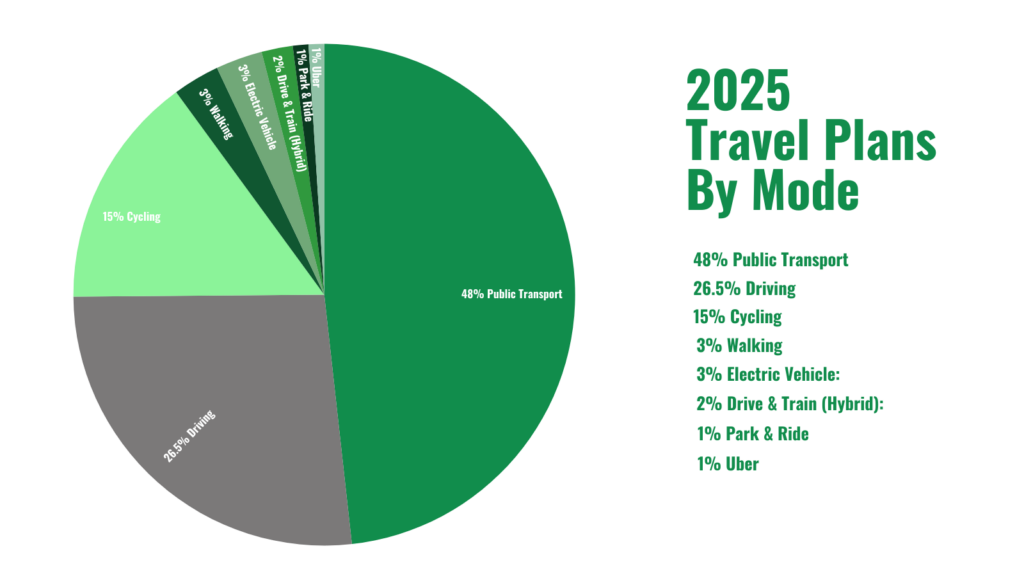
The travel choices recorded through the travel assistant showed a strong mix of sustainable modes. Public transport was the most popular option, making up 48% of all journeys. Cycling stood out at 15% – higher than we typically see at similar events – and suggests that many attendees felt confident making use of active travel routes across Newport.
Driving accounted for 26.5%, with walking and electric vehicles each contributing around 3%. A small number of delegates combined driving with rail, or arrived via park-and-ride or taxi.
Overall, this reflects a healthy balance of lower-carbon options shaped by the venue, the travel information shared in advance and the transport choices available locally.
Where delegates travelled from: 2024 vs 2025

Looking at where people travelled from adds another layer. Across both years, most delegates began their journeys in Cardiff, Newport or the surrounding South Wales region. But the 2025 map shows something new: more people travelling from further afield, particularly Birmingham and London.
In 2024, only a handful of longer-distance journeys appeared. In 2025, they were noticeably more present. It suggests that the conference is continuing to broaden its reach, drawing interest from organisations and individuals well beyond its immediate region – while still remaining rooted in the communities closest to it.
Looking back at 2024 and what stayed the same
The 2024 conference took place at The Riverfront Theatre and Arts Centre, also in Newport. Travel patterns that year looked very similar: public transport led at 52.2%, driving sat at 25.8% and cycling at 14%, with walking and EV travel each just over 3%.
The consistency across both years – despite being hosted at different venues—shows that when sustainable travel options feel straightforward, easy to follow and well supported, people tend to choose them. Any slight differences from year to year can largely be explained by the natural influence of venue location and surrounding transport connections.
Travel from the WSA Team
With the majority of the WSA team travelling to the Sustainability in Sport Conference from Cardiff, trains and buses were the modes of transport utilised by everyone.
One member of staff used the bus to get to Rodney Parade, while everyone else took the train from Barry, Cardiff and Pontypool.


How the ‘You. Smart. Thing.’ Team Made the Journey
As a WSA partner, ‘You. Smart. Thing.’ also made the trip using sustainable travel. One of the routes taken combined walking with a Great Western Railway service into Newport – a simple, low-emission journey that avoided congestion and the need for parking.
Below is an example of the travel plan used by the YST team:


This route generated 7.9kg CO₂e from door to door and showed how easy low-carbon travel can be when the options are clear and accessible.
What these travel patterns tell us
Looking across both years, the message is clear: when sustainable travel is visible, simple and well-supported, many people choose it naturally. Public transport consistently leads, cycling continues to perform strongly, and active travel and EV journeys appear each year. The wider spread of origins in 2025, including more travel from Birmingham and London, shows that even as the event grows, sustainable choices remain central to how people move.
As the WSA continues its work to embed sustainability throughout Welsh sport, travel will remain one of the most meaningful areas to reduce event-related emissions. With clear travel information and easy-to-use digital tools, it becomes far simpler to encourage and support low-carbon journeys. The patterns from the past two years provide a strong foundation for future events to build on.

















 English
  Welsh
Welsh