
Peak Exposure, a new campaign from the Melanoma Fund, premiered at Plas y Brenin National Outdoor Centre on 26–27 March, placing the issue of sun exposure directly in front of those responsible for managing risk in the outdoor sector.
The conference brought together national providers with reach across thousands of instructors, guides and outdoor professionals, making it a deliberate launch point for sector-wide influence.
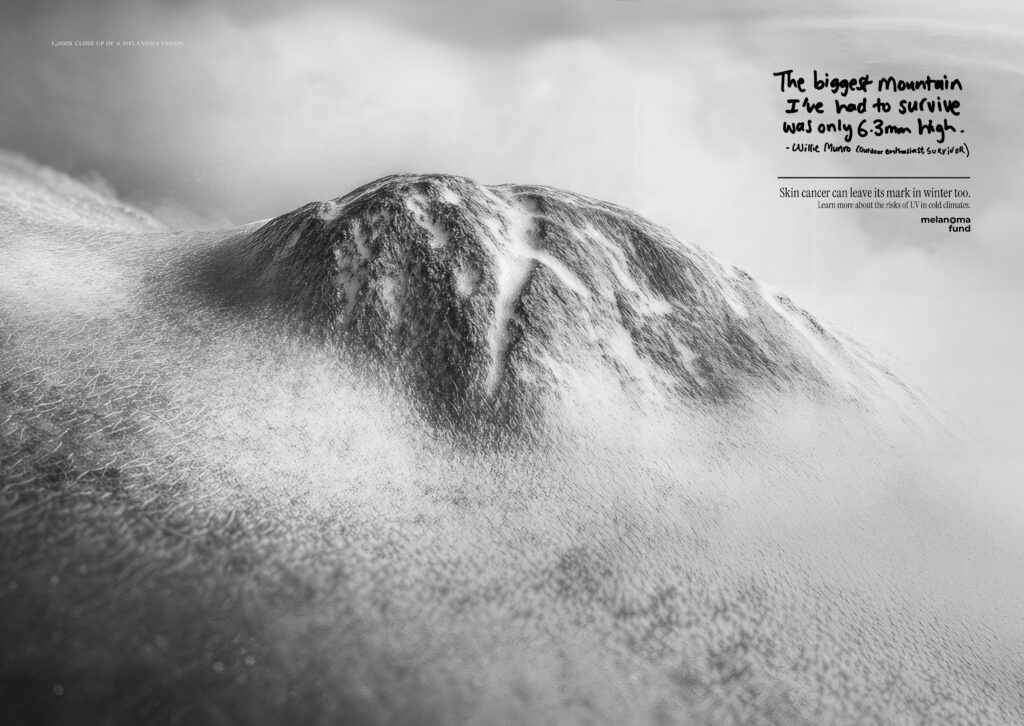
At first glance, the images appear to be dramatic mountain landscapes, ridgelines shrouded in mist, snow and ice catching the light. Look closer, and the illusion breaks. These are not mountains, but close-up images of melanoma and sun-damaged skin, shaped by years of UV exposure in the very environments they resemble.
The images are carefully constructed photographic works, capturing real skin detail in extreme close-up to mirror the texture, scale and form of mountain landscapes. This deliberate visual parallel reinforces the connection between environment and exposure, grounding the campaign in the physical reality of UV damage.
This approach builds on the Melanoma Fund’s previous collaboration with Neverland, whose Silhouettes campaign won four awards at the Creative Circle Awards, establishing a creative direction that uses visual disruption to challenge how skin cancer is understood.
The campaign has been developed in collaboration with Klick Health, who led the creative execution. Klick will be on-site capturing real-time audience reactions to the exhibition, providing insight into how the work lands and informing its future development across the outdoor sector.
The campaign features voices from within the outdoor sector, including Guy Jarvis, Mountaineering Instructor and Executive Officer at Mountain Training, whose image forms part of the series.
Guy Jarvis said, “Everyone warned me about avalanches. No one warned me about melanoma. In the mountains, we’re trained to manage risk, but sun exposure has never been treated in the same way. That needs to change.”
A cultural blind spot in outdoor safety
Skin cancer is now the most common cancer in the UK, with over 21,000 cases of melanoma diagnosed each year and significantly higher numbers of non-melanoma skin cancers. Despite this, sun exposure remains one of the most normalised and least challenged risks in outdoor activity.
Research from the Melanoma Fund highlights:
- 72% of coaches, leaders and teachers have never received training on sun or heat protection
- Only 16% of organisations have a dedicated sun protection policy
- Over two-thirds report sun or heat-related incidents, including sunburn and heat exhaustion
At altitude, UV levels increase by approximately 10–12% for every 1,000 metres gained, while snow can reflect up to 80% of UV radiation, intensifying exposure to the face and eyes.
From awareness to impact
Peak Exposure is designed to disrupt a long-standing gap between awareness and behaviour. By transforming melanoma imagery into familiar mountain landscapes, the campaign creates a moment of recognition followed by realisation, forcing viewers to confront the direct relationship between environment and impact.
Caroline Gleich, who recently underwent treatment for actinic cheilitis, a precancerous condition caused by UV exposure, makes that gap visible. Despite growing up with a strong awareness of skin cancer, she still experienced significant sun damage, reinforcing the physical reality of UV damage.
Embedding change through Sunguarding Outdoors
The campaign is designed to drive adoption of the Melanoma Fund’s Sunguarding approach, a practical framework for embedding sun and heat protection into everyday outdoor practice. This includes:
- The Sunguarding course – a CPD-accredited training programme for coaches and outdoor leaders
- Sunguarding Outdoors – sector-specific guidance and resources
- UV Safety Stations – infrastructure designed for outdoor environments to support behaviour in real-world settings
Sunguarding is being seeded across the outdoor sector through partnerships with the Mountain Training Association (MTA), with further engagement through Mountaineering Scotland and the Outdoor Industries Association.
Michelle Baker, CEO, Melanoma Fund said: “This isn’t about a lack of awareness. It’s about a disconnect. The damage happens now. The consequences come later – so it’s easy to ignore. These images remove that distance. They make the connection impossible to dismiss. It’s uncomfortable, but once you see it, you can’t unsee it.”
A sector that needs to change
While the initial launch reaches a relatively small audience, it is one with significant influence across the UK outdoor sector. By combining visual impact with a clear pathway to training and behaviour change, Peak Exposure is designed not only to raise awareness, but to act as a catalyst for long-term cultural shift in how sun exposure is understood and managed.
Outdoor organisations, instructors and partners are encouraged to engage with the Sunguarding course and resources via www.melanoma-fund.co.uk to embed sun safety into everyday practice.















 English
  Welsh
Welsh